
+++ The all-new ALFA ROMEO STELVIO is still on track for a 2025 reveal, but while it will be “100 percent electric” at launch, outgoing boss Jean-Philippe Imparato admitted market demand could see the company offer alternative fuels later down the line. An official statement issued earlier this year confirmed plans for a new Alfa Romeo Stelvio to be built at the Cassino factory in Italy, with a debut in the second half of 2025. That’s the facility that already produces the existing version of the family SUV, alongside the Giulia and Maserati Grecale. Alfa says the Stelvio will be the first model in Europe to use Stellantis’s EV-focused STLA Large platform. It has not issued any specs for the car, but we already know that the architecture beneath it can support the rear and 4-wheeldrive layouts that the Stelvio is likely to use. It can also accommodate battery capacities of between 85 kWh and 118 kWh, although the Stelvio’s positioning and pricing means it may not reach the larger of those sizes. Alfa Romeo does say, however, that the Stelvio will make use of STLA Large’s 800 volt electrics (it also supports 400 Volt), allowing rapid charging speeds of up to 4.5 kWh per minute, along with active anti-roll bars and terrain detection. Inside, it will also feature a curved dashboard display with over-the-air updates; features called STLA Brain and STLA SmartCockpit. But it seems (mild-hybrid) petrol and plug-in hybrid powertrains are not out of the question. Talking specifically about the Stelvio, as well as the closely-related Giulia, Imperato admitted his successor Santo Ficili “has the flex” to implement a multi-fuel approach on STLA Large if EV appetite among consumers continues to fall below expectations. Indeed, Imperato’s latest comments come straight off the back of confirmation Alfa Romeo will bring the MHEV-powered Junior to more markets, having previously sold it there only in zero-emission Elettrica guise. He reiterated, however, that “no BEV means no ICE”, confirming that stringent regulations ensure the firm can only offer petrol power if its EVs sell in strong enough numbers. The successor to the current Giulia will also be made at Cassino from 2026 onwards. Stellantis is investing heavily into its Italian facilities, having already made a commitment to build 5 electric cars (including 2 DS models, the next-generation Jeep Compass, the Lancia Gamma Electric and the Opel Manta Electric) on the STLA Medium architecture in Melfi. +++
+++ French sports car maker ALPINE is set to double-down on electric cars over the next few years, as it readies no fewer than 5 models spanning everything from hot hatchbacks to SUVs. A new, all-electric Alpine A110 will arrive in 2026, confirming the brand won’t turn away from its history as a sports car maker. Alpine CEO, Philippe Krief told me: “We know what we are going to do for 2024 to 2028, and now we are deciding 2029 and 2030. We want each model to translate the heritage of the brand: the lightness, performance, driving pleasure, and also the French savoir-faire”. The first Alpine EV model is the Renault 5 E-Tech based Alpine A290 revealed earlier this year. It may look only slightly fruitier than its sibling, but under the skin it packs up to 220 hp; enough for 0-100 kph in 6.4 seconds. It weighs less than 1.500 kg so it’ll be one of the lighter electric hot hatches on sale, though still heavier than an Abarth 500e. Next year, we’ll see the production version of the A390: a triple-motor electric SUV designed to take-on models like the Porsche Macan, which itself boasts over 600 hp in its tastiest tune. This model will pave the way for all that’s to come, with a new design language previewed by the A390 concept revealed at the Paris Motor Show this week. That concept car is said to be “85 percent true” to the showroom-ready version due in 2025. Arguably the most exciting of Alpine’s future line-up will be the successor to the A110, arriving in 2026. This car is seen as particularly important (at least internally) as it’s the model Alpine will use to springboard the business into new markets like China and the United States. Alongside the A390, it has the potential to elevate the brand from niche sports-car maker to a recognised premium player. Krief dismissed any idea that the next-generation Alpine A110 might attempt to replicate or mimic the synthesised engine sound or gearing found in a Hyundai Ioniq 5 N. “This is fake, really fake”, he told me. “I don’t like fake things like that. We can find something that is not the same, but it has its own power. It’s very easy to do that”. Alpine is refusing to lift its foot from the throttle and the covers will come off the company’s first drop-top in 2027. The Alpine A110 Roadster is understood to be a bonafide convertible rather than a targa-style coupe with removable roof panels; Krief said the A110 and its open-top sibling will be “completely different” but that the model “had to remain” to ensure Alpine’s authenticity. It will be “a real sports car, but in the electric world”, he said. The final confirmed Alpine EV will be launched towards the end of 2027, maybe early 2028. The A310 is thought to be a 2+2-style sports car or GT based on the same platform as the A110 but with an extra row of seats to boost practicality. Krief told us the car will sit between models like the Porsche 911 and BMW M4, acting as a “bridge between sports [cars]and something more roomy”. While that will take Alpine’s range to 5 distinct variants, 3 further models (1 more sports or supercar, plus 2 “more versatile” 90-badged cars) are due later. Their exact form remains under wraps, but a flagship 2-seater inspired by the Alpineglow concept (possibly with a hydrogen fuel-cell powertrain) is likely to form the basis of that last ‘10’ model. “We are working on this very seriously”, Krief told me. As for the 90 cars, a 4-door saloon and a second SUV seem most logical; probably a larger, Porsche Cayenne rival badged Alpine A590. Krief told me he has his sights set on the German premium brands: “Between Audi and Porsche: this is the kind of position, this is what we are targeting”, he told me. On the subject of fuel cells as an alternative to internal combustion engines (ICE), Alpine’s CEO confirmed that “mainstream is electric, but we won’t close the door on hydrogen, e-fuels, things like that; the supercar could be the promoter of this kind of technology”. But don’t expect any more Renaults in fancy frocks. The synergies between the latest Renault 5 and Alpine A290 won’t be repeated. “We will stay on our own, but with the AmpR platform”, Krief told me. +++
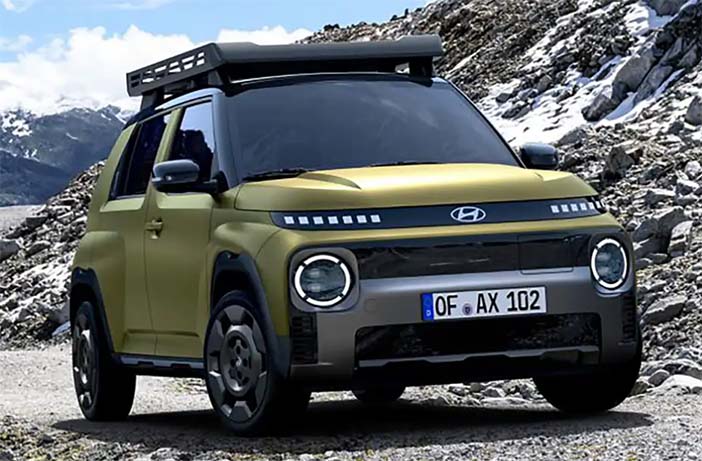
+++ Meet the new HYUNDAI INSTER CROSS : a rugged-looking, off-road-inspired version of the newly launched electric city car that appears ready for your next weekend camping trip. Changes for the new model include chunkier front and rear bumpers, skid plates, embossed black side cladding and a unique set of 17-inch alloy wheels. Roof rails are also fitted as standard, but customers will be able to add a roof basket for all their camping gear. The Inster Cross is available in an exclusive Amazonas Green Matte paint colour, while the interior features a unique colour scheme of grey cloth upholstery with lime-yellow accents and dashboard trim. It also offers the ability to fold down all four seats in the car, and a “walk-through” front cabin. Hyundai hasn’t confirmed whether both of the Inster’s battery and motor combinations will be available in the Cross variant, but we do know the ‘Long Range’ set-up will be. This uses a 115 hp e-motor to drive the front wheels, while the 49 kWh battery will offer up to 360 km of range. The Inster Cross can be recharged from 10 to 80 percent in about 30 minutes thanks to the maximum charging speed of 120 kW, while vehicle-to-load (V2L) capabilities means the car’s battery can be used to power other devices. Full specifications and pricing for the Inster Cross haven’t been confirmed yet, but like regular versions of the Inster, standard kit should include a 10.25-inch touchscreen, Apple CarPlay and Android Auto, LED daytime running lights, an energy-saving heat pump and keyless entry. There should also be a smattering of advanced driver-assistance systems, such as ‘Highway Driving Assist 1.5’ that combines adaptive cruise control with lane-keeping assist. +++
+++ Stellantis (the parent company of Peugeot, Opel, Citroen, Fiat and Jeep) will use its recently acquired stake in Chinese car brand LEAPMOTOR to “challenge” the influx of new models arriving at vastly reduced prices, Autointernationaal.nl can reveal. Speaking at the Paris Motor Show, Peugeot CEO Linda Jackson revealed part of the plan when Stellantis invested in Leapmotor was to “keep our friends close, and learn something about them”. She said it gave the group “another weapon to be able to react” to fierce competition from China. Jackson, while not directly connected to the Leapmotor acquisition, admitted there would be benefits for Peugeot, as well as other brands within the Stellantis stable. “It’s an opportunity to learn”, she told us. “They have a different positioning, a different offering in terms of what they are bringing to market. It’s just like having another brand”, she said. “It’s not impinging on Peugeot’s position. It gives us the possibility to be even more competitive”. Leapmotor International (the European arm of the Leapmotor and Stellantis merger) will utilise a number of existing Stellantis-brand dealerships in Europe, but there are no plans for other Stellantis brands to use the Chinese maker’s platform or battery technology at this stage. Stellantis is spreading its bets over its Smart Car and STLA platforms; the latter of which will eventually be available in Small, Medium and Large forms. Peugeot is already using the STLA Medium platform on its 3008 and 5008 SUVs, and while unconfirmed, is likely to favour the more advanced STLA Small architecture on its next-generation 208. All Stellantis platforms are believed to adhere to the company’s multi-fuel approach, supporting petrol, hybrid and electric powertrains. Leapmotor, which has already confirmed the T03 electric city car and C10 mid-size SUV for Europe, also revealed the more affordable B10 crossover in Paris. The Hyundai Kona and Kia EV3 rival will go on sale here in 2025. The Chinese company has promised 1 new car each year for the next 3 years. +++
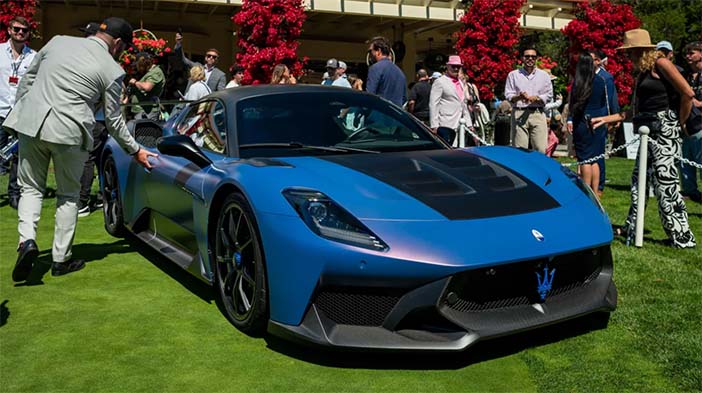
+++ This is a hardcore, track-focused yet still road-legal MASERATI MC20 GT2 STRADALE : the most extreme new supercar from the brand since the indomitable MC12, and the most expensive too, as it’s now available to order with a price tag of around €500.000. Based on the excellent Maserati MC20, the new GT2 Stradale is lighter, faster and features a dramatic new aerodynamic package, ready to fight off rivals such as the Porsche 911 GT3 RS and Ferrari 296 GTB Assetto Corsa. Designed as a bridge between Maserati’s MC20 road car and the GT2 racer, the Stradale’s fundamental carbon tub is shared with both, as is most of its carbon fibre body and basic engine. The engine itself is Maserati’s ‘Nettuno’ 3.0 V6 petrol unit, which features the brand’s unique dual-combustion chamber technology and a dry-sump lubrication system. Power is rated at 640 hp, 10 hp more than the regular MC20, extracted from new turbochargers and a new exhaust manifold system. This is backed up by new ECU mapping and a more free-flowing exhaust. Torque, oddly, is 10 Nm of torque down on the standard MC20 at 720 Nm, but it’s available between the same 3.000 rpm and 5.500 rpm rev band. Power is sent to the rear wheels via an 8-speed dual-clutch gearbox, and Maserati is quoting a 0-100 kph time of just 2.8 seconds, and a top speed of 322 kph. Alongside the performance bump, Maserati has focused on improving the road car’s cooling. This is most dramatically visualised by the Stradale’s vented carbon fibre bonnet, which now draws hot air from the front-mounted radiator and runs it through a new duct in the space where the front boot used to be in an MC20. The side intakes are also much bigger, and draw in 17 percent more air to help cool yet more radiators and feed the two charge-coolers mounted in the car’s flanks. This joins a far more aggressive aero package made up of a much deeper front bumper and sills, plus an aggressive rear diffuser. The front wings also feature Porsche GT3 RS-like vents that help reduce pressure in the front arches, aiding both front-end downforce and front brake cooling. Unique centre-lock forged wheels are also new, and save 19 kg compared to the MC20’s standard wheel package. Joining the ground-based aero is a huge stacked rear wing mounted on race car-like swan-neck supports. Maserati’s designers have also integrated a small central dip on the wing itself; a design flourish referencing the same design element found on the front grille. Maserati quotes a peak downforce figure of 500 kg at 280 kph, 355 kg more than the MC20. Depending on specification, Maserati quotes a dry weight of just 1.365 kg which is up to 135 kg less than the MC20. More changes have been made inside the cabin, starting with a brand new centre console which is lighter and mounted higher up. This includes a different placement of many of the car’s main controls, including the driver-mode switch at its centre. The new bucket seats are made by French company Sabelt, and pair with a standard-fit half-roll cage mounted behind. Maserati’s also modified the steering wheel, giving it a marginally thicker rim, removing some of the controls and fitting a set of LED shift-lights onto its upper section. Customers can also select one of two performance packs, the first incorporating a set of sticky Cup 2 R tyres, carbon ceramic brakes, an electronically-controlled limited slip differential and specific stability and traction control setups. The second ‘Performance Plus’ package adds four-point racing harnesses and a mounted fire extinguisher. +++
+++ In Germany, tensions at the carmaking giant are running high as the specter of factory closures, which would be a first for the company in the country, sets it on a collision course with worker representatives who make up half of its supervisory board and can sway decisions on company strategy. VOLKSWAGEN ’s works council chief Daniela Cavallo said that talks with the carmaker over planned cuts to its German sites were “abysmal” at the start and continued to be “serious, critical and controversial”. The 3.6% raise over a period of 27 months (announced formally by the regional employers’ association Nordmetall and in line for what would be put on the table nationally) is considerably lower than the 7% sought by the union. “We expect the company to finally present a master plan for the next decade that will ensure employment and capacity utilization”. In the first round of negotiations in late September, unions called for a reinstatement of job guarantees extending beyond 2030, utilization of all German sites and a 7% raise in line with IG Metall’s wage demands for the entire industry, on which separate negotiations are ongoing. +++
+++ The next-generation VOLKSWAGEN GOLF could be offered with a choice of petrol, hybrid and fully electric powertrains, with a single body disguising a pair of platforms, much like the latest Mini Cooper. Speaking from the Paris Motor Show, Martin Sander, board member for sales, marketing and aftersales at Volkswagen Passenger Cars, told the company wanted to build on its ID electric car brand, rather than simply returning to household names for future models like Polo and Golf. “ID is a really strong brand”, Sander told me. “There is an ID community; ID drivers meet up once a year at Lake Como. This shows that ID in itself is becoming a strong brand. We need to think very, very carefully about whether we want to ditch that. “The future of individual mobility will be electric, whether that is 2030 or 2035, the future will be electric. So if we want to be market leaders in the future, we will have to have a strong name that reflects this ambition of us being number one”, he said. But Sander hinted that as well as building on its ID brand, the firm wouldn’t ignore the fact that electric car demand was softening across Europe, suggesting that it’ll continue to develop its range of petrol and hybrid cars towards the end of the decade and beyond. “As long as we see customers demanding vehicles with a combustion engine; we are one of the largest car companies in the world, we will offer that”, he told me. “Sooner or later there will be an end date, but right now it is too soon to say”. However, I know that the next-generation T-Roc, which is due soon, will be the last all-new petrol Volkswagen. This means the company will need to refresh and adapt its existing ICE cars if it wants to keep selling them through to 2030 and beyond. When asked if we might see Volkswagen adopt a similar strategy to the likes of Mini, whereby it puts what is a visually similar body, albeit with key structural differences, on top of both ICE (MQB) and EV-specific (MEB) platforms, Sander suggested a desire to converge the firm’s differing designs. “I think it’s important that we have a clear Volkswagen design language”, Sander told me. “From the next launches you will see lots more clarity on the way our vehicles are designed. What does Volkswagen stand for?” he asked. “It stands for solidness and reliability; you want Volkswagen as a brand to be likeable. This will apply to ICE vehicles and EVs, across the whole Volkswagen family”. I expect, therefore, to see a ID.Golf launched alongside an all-but aesthetically identical ICE Golf before the end of the decade, possibly replacing the ID.3 and Mk8 Golf in one swoop. +++