
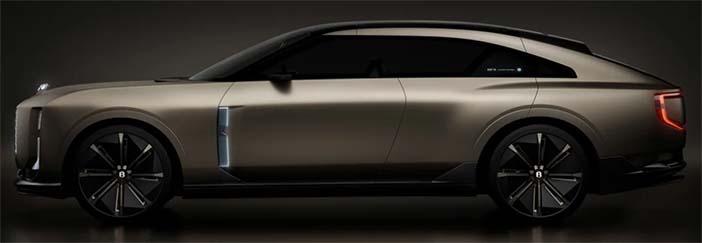
+++ Like many automakers rethinking their electric ambitions, BENTLEY is pressing pause on its sprint toward an all-EV lineup. The luxury British marque is stretching its timeline, now aiming for a fully electric range by 2035 instead of the earlier target. The company will continue to produce internal combustion engine vehicles and introduce additional hybrid models to meet evolving market demands and regulatory requirements. The next-generation Flying Spur will also likely reflect this change in tact, offering hybrid, plug-in hybrid and fully electric versions. Earlier this year, the British luxury brand unveiled its EXP 15 fastback concept, offering a glimpse into the future design language of its electric vehicles. With that in mind, I expect some of the concept’s less controversial elements to carry over to the next Flying Spuras well. Starting at the front, the photoshop image features a rectangular version of Bentley’s signature upright grille, accompanied by a colour-coded lattice structure and backlit illumination. Gone are the ovoid themes of old, replaced by slim vertical LED headlamps that emphasise a staunchly geometric and upright appearance. The concept’s long bonnet and sloping rear roofline would make the transition into series production, as would the bold shoulder line transitioning into the rear haunches. Frameless windows add a streamlined aesthetic; however, flush door handles don’t make the cut due to expected regulatory changes surrounding safety implications. At the rear, a slim halo-style OLED taillamp cluster is set within a smooth panel, paired with a minimalist diffuser and active aero elements. A contoured decklid and subtle lip spoiler will cement the go-fast look. Inside, the cabin will likely mirror that of the EXP 15 (minus the concept’s unusual three-seat layout), empathising analogue luxury with digital finesse. Key features may include a curved windshield that extends into a display roof with adjustable transparency, complemented by a retractable digital headliner for augmented reality overlays. The dashboard could feature a flexible, wing-shaped design with backlit wood veneer and dual OLED displays, alongside tactile knurled controls and haptic surfaces. Other goodies could include an 87-inch augmented reality head-up display and AI-driven voice assistance. Rear occupants will be greeted with a standard array of premium amenities, including reclining massage seats, ambient lighting, fold-out tables, and modular display pods. Powertrain-wise, we could see a return of the pure internal combustion engine (ICE) alongside plug-in hybrid (PHEV) and EV variants. The former will use a revised twin-turbo V8 delivering between 600 and 700 horsepower, and over 900 Nm of torque. The PHEV variant is expected to feature a carryover V8 engine and a rear electric motor, both of which are coupled to a 25.9 kWh battery. In this guise, figures exceeding a combined 780 hp and 1,000 Nm of torque are sent to all 4 wheels via an 8-speed dual-clutch transmission. Shared with the upcoming Porsche Cayenne electric, the full EV version could produce as much as 1.000 horsepower and utilize a 113 kWh battery pack (with wireless charging), capable of a range of nearly 595 km. As the Flying Spur competes at the upper echelon of the luxury sedan market, it targets those with trust funds and a penchant for spending. Primary rivals include the more opulent-oriented Rolls-Royce Ghost, and the slightly more mainstream-derived Mercedes-Maybach S-Class, and even Huawei’s new Maextro S800 in China. Expect more information about the Flying Spur in the coming months as Bentley reveals more of its future strategy. A reveal is anticipated in late 2026 or early 2027. +++
+++ The electric car age has rewritten the meaning of quick, with even family runabouts now capable of supercar-style launches from a set of lights. What once belonged to exotic badges has become a party trick for mid-range sedans and crossovers alike. Now CHINA ’s latest draft vehicle regulation looks set to spoil the fun, or at least delay it. Under a proposed update to the National Standard, every passenger car would need a default mode in which it takes no less than 5 seconds to reach 100 km/h at startup, unless the driver manually selects a quicker setting. The draft title “Technical Specifications for Power-Driven Vehicles Operating on Roads” appears to be part of a broader safety and road behaviour initiative in China. It is intended to replace the current GB 7258-2017 standard that didn’t impose such restrictions. Section 10.5.4 of the new proposal states: “After each power-on/ignition of a passenger vehicle (excluding automatic engine start-stop), the vehicle should be in a state where the 100 km/h acceleration time is not less than 5 seconds”. The default performance-restricting mode at startup could work much like the output-limiting Eco setting found in most EVs, managed entirely through software. Drivers could still switch to a faster mode, though they’d need to repeat the process every time they power on the car. Europe has a somewhat parallel rule, requiring cars to have speed limit warnings, although those systems only alert rather than restrict. If approved, the rule would apply to all passenger cars in China regardless of powertrain, though it would most affect the growing fleet of lightning-fast EVs. Models like the Xiaomi SU7 Ultra (1.98 seconds to 100 km/h), Zeekr 001 FR (2.02 seconds), Tesla Model S Plaid (2.1 seconds) and BYD Yangwang U9 (2.36 seconds) would all fall under the new restriction, even if only temporarily after startup. A separate draft titled “Safety Specifications for Power-Driven Vehicles Operating on Roads” includes another speed-related rule, this time targeting longer passenger models. Section 10.5.1 reads: “Passenger vehicles with a length of 6 meter or more shall have an overspeed alarm function, capable of triggering an alarm via visual or audible signals when the speed exceeds the maximum permissible speed (the maximum permissible speed shall not exceed 100 km/h), except for those with compliant speed limiting functions or devices”. While most large SUVs and minivans stay below the 6-meter mark, the rule could apply to stretched limousines. One such example is the previous-generation Rolls-Royce Phantom VII Extended Wheelbase, which measures 6.092 mm. Its successor, slightly shorter at 5,982 mm, would just avoid triggering the alarm requirement. +++
+++ FORD RACING is on the cusp of unveiling its first “all-new” sports car since its motorsport and road-car operations were merged. At its 2026 season launch event on 15 January, it will provide a first glimpse at the new car, described by Ford Racing chief Mark Rushbrook as “a testament to how deeply we’re integrating our racing innovation into the vehicles you drive every day”. It will be the first in a new line of models after Ford Performance was overhauled with a view to strengthening the relationship between the brand’s road cars and its thoroughbreds. What form the new car will take remains yet to be announced, but there are several possibilities. Ford CEO Jim Farley recently hinted at the prospect of a 1.000 hp Ranger Raptor pick-up inspired by the brand’s Dakar Rally contender, for example, telling Bloomberg: “No one has ever built a supercar for gravel, high-speed sand, dirt”. Prototypes of an updated Ford Mustang GTD supercar with a more aggressive aerodynamics package have also been spotted testing at the Nürburgring Nordschleife. Ford is looking to usurp long-time rival General Motors’ Chevrolet Corvette ZR1 after it took the record for American cars at the hallowed German circuit earlier this year, but Ford’s description of the imminent arrival as “all-new” would suggest it won’t be a variant, but rather a bespoke model. Alongside the hint at the new performance car, Ford will use its January launch event to give more details of its new Formula 1 powertrain, which will power next year’s Red Bull and Racing Bulls cars. +++
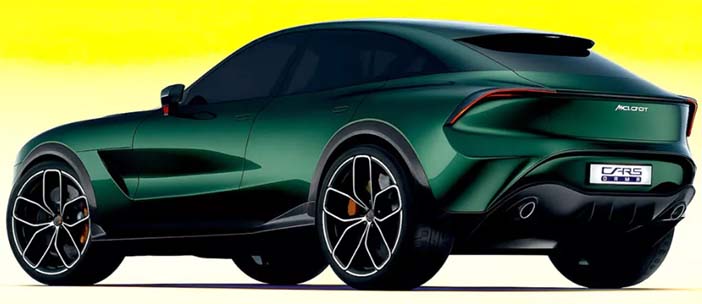
+++ MCLAREN has quietly been developing a high-performance model with “more than 2 seats” for some time now, and it appears that the project has finally taken shape ahead of its expected debut in 2028. Dealers say the upcoming big McLaren will take the form of an SUV powered by a hybrid system. The company also plans to introduce several new models over the next 3 years, signalling a notably busy stretch for Woking. While many expected McLaren’s first high-riding vehicle to be on the compact side, that assumption seems off the mark. One dealer who previewed the clay model described it as having a silhouette reminiscent of the Porsche Cayenne Turbo GT, only larger, with a “sculpted and muscular” stance set over 24-inch wheels. According to the same source, the SUV “has presence and won’t get lost in the exotic SUV segment” alongside competitors like the Ferrari Purosangue, Lamborghini Urus and Aston Martin DBX. The new SUV will be among the first production models to showcase McLaren’s updated design language, first teased last year. Expect details such as split headlights that sit flush with the body, a hood scoop, a defined spine running across the roof, and a bolder rear section featuring a large spoiler, diffuser, and large tailpipes. The 4-door McLaren, codenamed P47, will reportedly feature a hybrid system centerred on a V8 engine. While McLaren hasn’t confirmed the underlying platform, it’s understood that the SUV won’t use the carbon monocoque chassis from the company’s supercars. Earlier reports suggested the automaker has been evaluating several shared-architecture options. During a global dealer meeting, McLaren revealed more details about its future strategy. The company plans to roll out at least one new model every year through 2028. According to the newly appointed CEO Nick Collins, the expanding line-up won’t compromise the brand’s performance DNA. In 2026, the brand will launch its W1 flagship hypercar, now in the final stages of development. Early 2027 will bring the hardcore 788HS, the most extreme evolution of the 750S and successor to the 765LT, limited to 200 units split between coupe and spider variants. McLaren is also developing a new supercar featuring a mild-hybrid V6 expected to produce around 800 hp. Due in 2027, it will sit above the entry-level Artura and feature a cabin described as “upscale,” with wraparound design elements, Nappa leather trim, and vivid digital displays for both infotainment and instrumentation. The future lineup could also include a 2+2 grand tourer to replace the GTS. By 2028, McLaren is expected to introduce both a spider variant of the W1 hypercar, equipped with a removable 3-piece hardtop and a successor to the 750S designed to rival the Ferrari 849 Testarossa. Earlier this year, McLaren was acquired by CYVN Holdings from Abu Dhabi and merged with startup Forseven. The investment group also holds a stake in Chinese EV maker Nio, which will supply components for future McLarens. Additionally, CYVN controls Gordon Murray Design’s EV division, which is set to collaborate on research and development across McLaren’s upcoming electrified line-up. +++
+++ NISSAN has started testing its new electric Juke (the divisively styled ‘Marmite’ sibling to the new Leaf) on public roads ahead of a launch next year. The Japanese firm’s answer to the Ford Puma Gen-E and Opel Mokka Electric is set to begin production in Sunderland in the coming months. It will play a crucial role in growing Nissan’s EV mix as the electric equivalent of one of Europe’s most popular SUVs. The Juke EV will be built and sold alongside the new Leaf, which has morphed from a hatchback into a crossover for its third generation, and at 4.350 mm long is a very similar size to the Juke, which raised the question of how the duo will be differentiated from a customer perspective. Nissan’s chief performance officer Guillaume Cartier told that buyers of the firm’s SUVs “are a totally different profile, with nothing in common”. He said Nissan’s market intelligence shows there is no “hesitation” between buyers of the firm’s current SUVs because they occupy completely “different customer bubbles”. He acknowledged that the new Leaf is almost identical in size to the current Qashqai, for example, but said the 2 cars occupy entirely different positions in the Nissan line-up. “One is SUV, the other is more coupé-sedan; one is E-Power, the other is electric”, he explained. “Then you have Juke, and Juke is Marmite”. Cartier said the Juke EV will be purposely divisive in its styling, as have been the previous 2 generations, both to set it apart from its range mates (including an electric Qashqai, due by the end of the decade) and to make an impact in the burgeoning electric crossover segment. Can an interior-focused revamp continue the market-shaping crossover’s appeal until it goes electric? “You will have people who say ‘wow’ and people who say ‘no thank you, not for me’. Based on that, I think this car will not be compared to anything else”, he said. Cartier believes there is “room in terms of pricing”, powertrain and spec differentiation when it comes to carving out different “market segmentations” for the Leaf, Qashqai and Juke, “but I’m much simpler: I make sure that Juke and Qashqai do not overlap and Juke is Marmite”. The camouflaged prototype seen by photographers in Spain doesn’t give much away, beyond the obvious proportional similarities to today’s car, as well as the preservation of defining cues like the heavily raked roofline and visor-shaped side windows, but clearly it will be markedly different to the Leaf and Ariya. An earlier official preview image revealed that the Juke EV will have its own distinctive light signatures and heavily accentuated body lines, as previewed by last year’s radical Hyper Punk concept. The Juke EV will use the same CMF-BEV platform as the Leaf and is expected to use the same batteries and motors as that car. We therefore expect a maximum range of more than 560 km and a choice of single-motor powertrains giving up to 218 hp. Nissan Europe’s R&D boss has previously suggested that it could have a bespoke chassis set-up in a bid to accentuate its differentiation from the Leaf and promote its more ‘dynamic’ character. “As the size of the car grows, you change its ride and handling characteristics, or if it sits in a different segment, you might change the suspension”, David Moss said. Nissan has previously said it’s aiming for the Juke EV to cost less than the current Juke, which starts at around 30.000 euro, although it has admitted that’s a challenge. It has yet to give a precise launch timeline but has confirmed that the life cycle of the current Juke will be extended and it will be produced alongside the Juke EV at Sunderland, which also builds the Leaf and Qashqai. +++
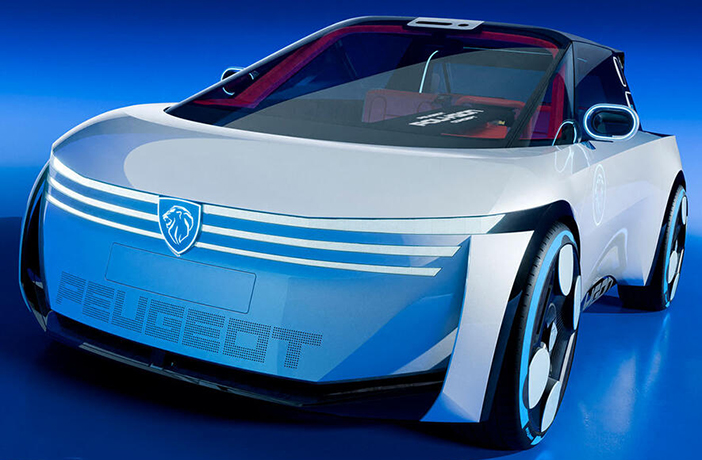
++ The next-generation PEUGEOT 208, set to be the brand’s first car to feature a steer-by-wire system, has been previewed by the new 205-inspired Polygon concept. Measuring just under 4 metres long, the Polygon is so named because it has a rectangular steering wheel, which is key to the next iteration of Peugeot’s signature i-Cockpit dashboard design.
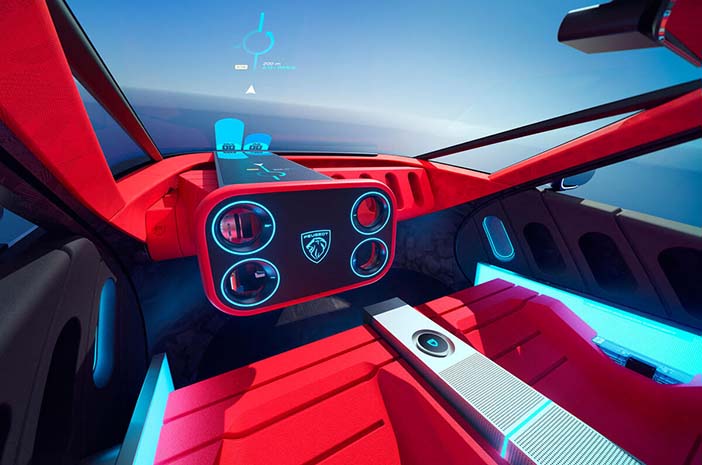
This steering ‘wheel’ is not physically linked to the front wheels mechanically but instead uses electronic connections to transmit the driver’s inputs to the steered wheels. This frees up space to completely reinvent the topology of the dashboard: the wheel is set high on the dashboard and there is no traditional instrument binnacle. Instead, information is projected from inside the dashboard onto the Polygon’s windscreen, giving a display space equivalent to a 31 inch touchscreen. The steering wheel’s narrow profile means it does not obstruct the driver’s view of this projection. The climate control system is displayed on a small screen atop the iDrive-style dial controller on the centre console. At low speeds the steer-by-wire reaches full lock when the steering wheel is rotated by just 170 degrees in one direction, so going from lock to lock will require only 1 full rotation of the wheel, rather than 3, as in the current 208. Peugeot says the steering’s quickness provides a sense of “hyper-agility”, with the rack automatically slowing its rate of response at higher speeds for greater stability. This will be key to the dynamic identity of the brand going forward, CEO Alain Favey previously told. Traditional seats have also been rejected in favour of racing-style chairs comprising 3D-printed shells and large single pieces of moulded foam, which have a protective coating. These can be swapped out in minutes, in theory enabling owners to change the design or colours as they please.
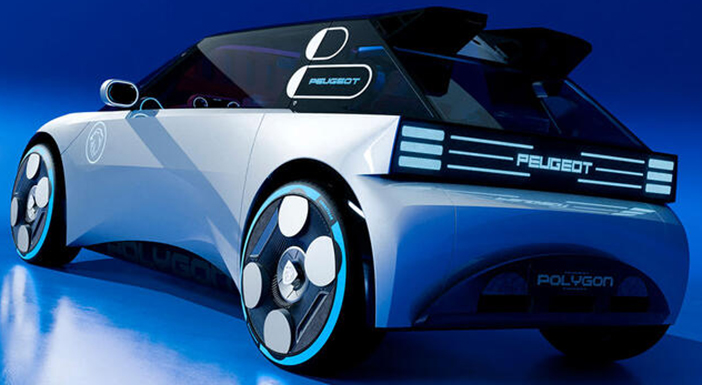
Notably, the Polygon is a 3-door hatchback, rather than using the 5-door design of today’s 208. Although unlikely to make it to production, the concept’s ‘XXL’ gullwing doors provide easier cabin ingress and reduce the number of parts required, which in turn saves costs, said Peugeot. The Polygon is short and squat with minimal overhangs and little room under the bonnet for a combustion engine, all of which suggests it has been conceived solely as an EV. Its scuttle sits as low and as far forward as possible to improve visibility of the road ahead and to let in more natural light; the glasshouse stretches across the entirety of the Polygon’s roof and tailgate. At the front end, the Polygon introduces a new interpretation of Peugeot’s ‘3-claw’ lighting signature, with LED light bars stretching across the width of the car. The rear treatment is reminiscent of the Peugeot 205, with a flat-faced design and distinctive square brake lights. The C-pillar also references the 205 GTi, reimagining that car’s lozenge-shaped badges as LED lights indicating the Polygon’s state of charge. Peugeot has yet to confirm when the next 208 will go into production but said the Polygon’s steer-by-wire technology is due in showrooms from 2027. This suggests the tech could be destined for the 208, which will be due for replacement at around that time. The new 208 will be the first car to sit on parent company Stellantis’s STLA Small architecture, and the model is not set to offer a combustion engine option. Battery capacities for the platform will range from 37 kWh to 82 kWh, promising significant improvements in range compared with the 427 km offered by today’s e-208. +++
+++ We can now add SUBARU to the growing list of carmakers easing off their all-electric investments, as shifting consumer tastes and surging demand for hybrids reshape the market. The move could see several of Subaru’s planned EVs pushed further down the timeline. During the automaker’s most recent earnings briefing, president Atsushi Osaki blamed “increasing demand for hybrids and the reappraisal of internal combustion engines” as the reason for delaying “the timing of full-scale EV mass production investment”. Subaru had committed 1.5 trillion yen, or about $9.74 billion, in electrification by 2030. It has already poured in 300 billion yen ($1.94 billion) of this amount, and while the remaining 1.2 trillion yen will still be invested, they will be “reviewed”. In the immediate term, the timeline change won’t have a significant impact, as the company still plans to launch four electric SUVs built in collaboration with Toyota by the end of 2026. However, it may delay 4 other EVs that it had planned to develop in-house by 2028. The trend towards hybridization has been apparent over the past 18 months, prompting other car manufacturers, like Hyundai, to increase investments in this space. Compounding this shift are economic headwinds. With the loss of the federal EV tax credit in the United States and the added burden of steep automotive tariffs, manufacturers are being forced to tighten budgets and spend more strategically. Subaru says it expects to take a 210 billion yen ($1.36 billion) impact from the tariffs this year. For the financial year ending March 2026, it expects a net profit of 160 billion yen, a massive 53 percent decline from the year prior. To cushion the blow, Subaru plans to trim costs by 200 billion yen ($1.29 billion) by 2030, an efficiency drive meant to steady the balance sheet as the market evolves. The newest EV in Subaru’s portfolio is the Uncharted, a reworked and rebranded version of Toyota’s latest electric C-HR. Subaru has given it a tougher, more adventurous character, staying true to its outdoorsy image even as it reconsiders how quickly to go all-in on battery power. +++
+++ For the second time this year, TOYOTA has delayed its plan to build a new factory dedicated to EV batteries in Japan’s Fukuoka Prefecture. The decision, while not unexpected, highlights the company’s cautious approach amid fluctuating global demand for electric vehicles. Sales of Toyota’s EVs have slowed, yet the automaker maintains that the plant will still move forward in due course. Toyota paid roughly 6 billion yen, about $39 million, for the site located in an industrial zone under development in northeastern Fukuoka Prefecture. As part of the purchase, the company agreed to begin construction within 3 years. Despite this, the car manufacturer announced in March that it would postpone work at the site due to fall demand for its EVs. The governor of Fukuoka, as well as Toyota President Koji Sato, have since confirmed work on the site has been postponed for a second time. Production had initially been slated to start in 2028, though an updated timeline has yet to be provided. Word of the delay coincided with Toyota’s latest earnings report. It cut its global EV sales expectations by 10 percent from a previous forecast of 277.000 units for the fiscal year ending March 2026. Even so, Toyota hasn’t ruled out adjusting its long-term targets, including its aim to reach 1.5 million global EV sales in 2026, a figure that could yet evolve as market conditions change. Notably, Toyota is still investing heavily in new electric vehicles and factories. It continues to work towards opening a new factory in Shanghai, China, around 2027, to produce EVs for Lexus. This facility will likely handle the production of the LF-ZC and LF-ZL that were introduced a couple of years ago as concepts. Toyota’s EV sales through the first nine months of the year were actually up 20.6 percent to 117,031 units, but even so, that number has still fallen short of expectations. Until the company is confident that sales will rise significantly, it doesn’t make sense to rush and build new plants only for them to sit idle or operate at partial capacity. +++