
+++ Renault, Nissan and Mitsubishi plan to triple their investment to jointly develop Electric Vehicles (EV), 2 people with knowledge of the plan told the media. As established automakers face pressure from new competitors and an expected shift in demand toward EVs, the French-Japanese ALLIANCE is seeking to deepen cooperation. The 3 are expected to announce on Thursday a plan to invest more than €20 billion over the next 5 years on EV development, the sources said. By 2030, the alliance is expected to come up with more than 30 new battery-powered EVs underpinned by five common platforms, they said. That is in addition to €10 billion the group has already spent on electrification, said the 2 people with knowledge of the plan. A Nissan spokesperson declined to “comment on speculation”. Spokespeople for Renault and Mitsubishi did not respond to requests for comment. The “Alliance to 2030” plan aims to show “intensified cooperation” among the automakers, highlighting a “shared vision on electrification and connected mobility”, 1 source said. The 5 common platforms are expected to cover 90 % of EVs the companies are expected to develop and launch by 2030, the sources said. The 3-firm alliance has already developed and partly deployed 4 common EV platforms. 1 underpins EVs such as Nissan’s upcoming Ariya and Renault’s Mégane E-tech Electric, while another supports affordable no-frills cars by Nissan and its China market partner Dongfeng, as well as for Renault’s Dacia brand. The other 2 are platforms for micro minis (called “kei cars” in Japan) and light commercial vehicles. By mid-decade the alliance aims to deploy a fifth common platform for compact EVs designed by Renault, the sources said. Nissan has already decided to use this platform, called CMFB-EV, and other standardized components to electrify the Micra compact car, while Renault is expected to come up with a similar EV car based on the same platform. The Micra EV is projected to be released by the mid-2020s. According to sources, the automakers hope to make compact EVs as affordable as gasoline-fueled vehicles of similar size. The automakers are expected to use common batteries and other key components. The alliance plans to jointly invest in capacity to produce in France, Britain, China and Japan a total of 220 gigawatt hours of battery capacity by 2030 under the plan, the sources said. By standardizing and sharing batteries, the alliance expects to cut battery manufacturing costs in half. The alliance is also expected to share solid-state lithium-ion battery technology, which Nissan has been developing, they said. The plan had been for the leaders of Renault, Nissan and Mitsubishi to announce the 2030 plan last autumn at an event in Japan, but the announcement was postponed until this week because of a surge in Covid-19 in Japan. A disagreement between Nissan and Renault over the French firm’s proposals for a full-blown merger (tensions that burst into the open with the arrest of former alliance leader Carlos Ghosn in 2018) corresponded with stalled efforts to collaborate on technology and vehicle development, people with knowledge of the matter have said. The 3 automakers all have their own hybrid technologies with few shared key parts and systems. Sources noted that the limited cooperation in sourcing and development has raised concern within the group about the ability to achieve cost savings. It was not immediately clear whether alliance leaders will discuss hybrids as part of their 2030 plan. Nissan said in November it planned to spend ¥2 trillion over 5 years to accelerate vehicle electrification, launching 23 electrified vehicles (including gasoline-electric hybrids and 15 EVs) by 2030. Half of Nissan’s vehicle mix will be electrified by 2030, including EVs and hybrids, the company said. Renault has said its Renault brand will be 100 % electric in Europe by 2030, but company officials said the target does not apply to markets outside Europe and the group’s other brands, such as Dacia. +++
+++ Logistics companies in JAPAN , striving to cut costs and make the most out of the pandemic-inspired online shopping boom, are finding an unlikely white knight in Chinese electric-vehicle manufacturers, whose vans make last-mile deliveries not only cheaper, but cleaner as well. Tokyo’s SBS Holdings, a listed logistics company that offers deliveries, recently struck a deal to buy 2.000 light EV trucks over 5 years from Japanese EV startup folofly. The cars will be made by a unit of Dongfeng Motor Group as well as other Chinese automakers. Sagawa Express, meanwhile, will utilize 7.200 low-priced electric minivans made by Guangxi Automobile Group. “Japanese EVs don’t meet our costs”, SBS Holdings president Masahiko Kamata said. “Japanese automakers say it’s impossible to lower prices, so we had to buy cheaper vehicles. We can’t ask our customers to accept increased fares just because we have more expensive trucks”. Like most places around the world, online commerce has soared in Japan during Covid-19 as people order everything from food to clothing and electronic gadgets right to their doorstep. Those increased sales are pushing up logistics companies’ carbon footprints. Yet Japan has pledged to cut emissions almost 50 % relative to 2013 levels by 2030. To meet that target, 90 % of vehicles sold in the nation by that year will need to be battery-electric ones, according to McKinsey. SBS plans to eventually have a fleet of some 10,000 commercial EV vans that it can use for e-commerce deliveries. The small trucks can run for about 200 kilometers on a single charge and cost around ¥3.8 million ($33,000). “The range isn’t a huge issue for last-mile deliveries”, said Akira Miyahara, a manager at SBS Sokuhai Support, SBS Holdings’ rapid-delivery unit. While there’s a question mark over how the Chinese vehicles may perform after 3 or 4 years, for now, after 12 hours overnight on the charger, there’s no problem. Although Japan isn’t currently a huge market for electric vehicles (EV penetration runs at just 1 % versus 30 % in some cities in China) Chinese automakers sense an opportunity. BYD already commands around 70 % of Japan’s pure electric bus market and aims to have 4.000 such buses running in the country by 2030. “Japan is well established in the automotive industry due to its reputation as a quality-oriented market, so entering the Japanese market is an important step”, a BYD Shenzhen-based spokesperson said. “BYD Japan will continuously promote the electrification of transportation to accelerate the realization of carbon neutrality”. Representatives for Dongfeng Motor didn’t respond to requests for comment. Guangxi Automobile said its deal would “accelerate the Japanese market development of micro new-energy logistics”. Thanks to Chinese government incentives and subsidies, the average price of electric cars has dropped in the world’s biggest car market, while it’s risen in Europe and the U.S. An August report from JATO Dynamics, a London-headquartered global supplier of automotive business intelligence, found that consumers in China can buy a brand new EV for as little as $4,200. The price in Europe jumps to at least $17,880 and again to $28,170 in the U.S. “If Japanese automakers don’t do anything, China will take over the industry”, SBS Holdings’ Kamata said. It’s not only Chinese companies muscling in. Cenntro Electric Group, a U.S. maker of commercial EVs, received approval in November to sell light trucks in Japan, and will have its vans used by Amazon Fleet, Amazon.com’s local delivery partner, and Hana Cupid, Japan’s largest floral gifting association. Cenntro chief executive officer Peter Wang sees a bright future for home delivery in the nation due to Japan’s aging society. The company is even planning an assembly plant, potentially in Fukushima, to locally produce EVs and export some of them to Southeast Asia, he said. “EVs are still a cheaper option than hydrogen” for light-duty trucks, Wang said, with reference to the fact that Toyota, for example, is also exploring hydrogen as a future clean-car fuel. “They’re convenient, easy to use, easy to fix, easy to charge. I’ve talked to a lot of fleet managers in Japan and they couldn’t find the proper vehicle to do it”. Some observers worry that Japan’s nascent electric-car industry could face a similar crisis to that which befell its home-appliance sector. After dominating the world in the 1980s and 1990s, brands like Panasonic, Sony, Toshiba and Sharp lost out to cheaper Chinese alternatives. “If Japanese companies just stick to producing cars, foreign companies will come in”, said Hiroyasu Koma, CEO of folofly, the company working with SBS and Dongfeng Motor on the former’s fleet-electrification strategy. China has worked to create a whole infrastructure around EVs, including investment in CATL (now the world’s biggest EV battery maker) as a national strategy, Koma said. Toyota, the world’s biggest carmaker, still has the ability to turn things around, particularly if it focuses on making high-performing solid-state batteries, according to Takeshi Miyao, an analyst at Carnorama. “Chinese EV makers are at the fore when it comes to prices, but you never know if they’ll still be leaders in 3 years time”, he said. And Japanese truckmakers are beginning to fight back. Isuzu will start mass producing EV trucks in 2022 while Toyota unit Hino plans to sell the mini EV Dutro Z early this summer. Logistics company Yamato Holdings will use 2 Hino EVs through May and track to what degree CO2 emissions are reduced. But with Japanese EV trucks expected to cost about 3 times as much as diesel trucks, logistics companies may struggle to buy them, according to Kamata. +++
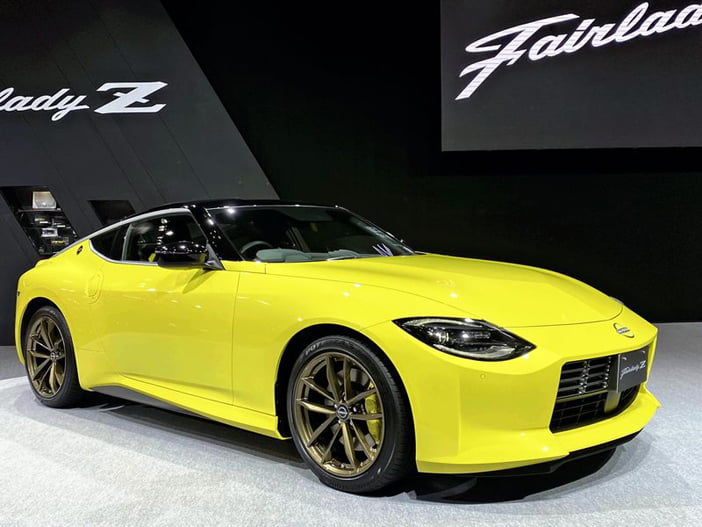
+++ NISSAN unveiled the latest model of its iconic Z sports car at the Tokyo Auto Salon, which ended Sunday. The new model is the seventh generation of the Z sports car, also known as the Fairlady Z, after its first full-scale revamp since 2008. The first generation of the Z sports series debuted in 1969. Equipped with the newly designed 3,0-liter V6 engine, the latest model is more powerful with improved acceleration. A special edition of the new model is scheduled to go on sale in late June in Japan, with the sticker price set at ¥6.97 million. The Tokyo Auto Salon, an exhibition for custom-made cars, was held for the first time in 2 years. Vehicles on display included Mitsubishi’s all-electric minicar, which goes on sale in the spring, and a custom-made version of the newest model of Honda’s Step WGN minivan. +++
+++ RENAULT ’s chief executive officer is fed up with the carmaker’s moribund business in China and willing to rip up the script the company and its alliance partner Nissan forged years ago to turn things around. The French auto manufacturer and its Japanese counterpart adopted a “leader-follower” strategy in May 2020, where each company would occupy the driver’s seat in certain regions and the back seat in others. The goal was to revive cooperation and squeeze savings out of an alliance strained by the 2018 arrest of long-time leader Carlos Ghosn. The plan assigned Renault, Nissan and Mitsubishi core geographies where they’d serve as a reference to the others to enhance competitiveness and share resources. But in setting out to turn things around in China, Renault CEO Luca de Meo has looked outside the alliance for help, pursuing a partnership with Geely Holding Group that includes selling hybrid cars in the world’s biggest auto market. “Renault’s whole strategy in China was wrong”, de Meo said on the sidelines of a media event last week. “It’s not Nissan’s fault. They may be leader in China, but they aren’t there to be charitable”. Announced last year, the tie-up with Geely (which also controls Volvo and has shareholding ties with Daimler) spoke to the still-tenuous nature of relations between Renault and Nissan. While the automakers have scheduled a briefing for January 27 to unveil new common projects, working together in China is low on their agenda. Renault didn’t involve Nissan in its discussions with Geely that yielded a preliminary agreement in August, according to people familiar with the matter. While the two used to cooperate in areas including research and human resources, collaboration and communication has dwindled, said one of the people, who asked not to be identified because the deliberations aren’t public. Representatives for Nissan didn’t respond to a request for comment. Makoto Uchida, Nissan’s CEO, told on Thursday that the “alliance will always have a strategic partnership together”. “We have been working on multiple new technologies for electrification, including platforms, e-powertrains and batteries within the Alliance”, Uchida said. “We have already 21 years successfully achieving collaboration and synergies. This spirit and mindset will continue and this momentum has to be enhanced”. Renault sold just 19.229 vehicles in China last year, dropping its market share in the country to 0.08 %. Nissan’s China sales fell 5.2 % to 1.38 million units, the automaker said January 6. “Nissan couldn’t rescue us”, De Meo said. Geely and Renault announced Friday they’re moving forward with part of their framework agreement reached 5 months ago. The Renault-Samsung plant in Busan, South Korea, will make hybrid and combustion cars using a Geely architecture and powertrain technologies, with production forecast to begin in 2024. The pair haven’t yet finalized talks for Geely to help Renault sell hybrid vehicles in China. Renault has a patchwork of partnerships in China that have been in a state of flux the last several years. It exited a venture with Dongfeng Motor in 2020 to focus on commercial vehicles and electric cars. In December of last year, it said its commercial vehicle venture with Brilliance Auto Group Holdings was unable to meet financial obligations and initiated a restructuring. It still has a production agreement with Nissan for the no-frills Dacia Spring, which is exported to Europe, and an EV venture with Jiangling Motors. “We’re trying to clean it up”, De Meo said of Renault’s business in China. The company likely will need a few years to pull off a project that’s innovative enough to stake out a share of the “pretty advanced” market, he said. +++
+++ The shortage of parts caused by the coronavirus pandemic is further denting production at TOYOTA , Japan’s top automaker. Production at 11 plants in Japan was halted Friday, and will be halted Saturday and Monday, Toyota said. That comes on top of reductions planned for February that were announced earlier. Those reduction will be on various days at 8 of its 14 plants in Japan, including assembly lines making the Prius and Lexus models. Supplies are running short because of a lack of computer chips, which are crucial in auto parts. Plants in and out of Japan have undergone lockdowns and stoppages related to Covid-19 measures. Toyota has not given details. Production in January will be reduced by 47.000 vehicles, when accounting for the latest changes, according to Toyota. For the fiscal year through March, production will now fall short of the 9 million vehicles the automaker had targeted, despite healthy demand for Toyota offerings. All manufacturers are scrambling to secure the tight chips supply, worsening the crunch, Toyota said. “We are doing our utmost to deliver our vehicles to our customers as soon as possible”, it said in a statement. “We deeply apologize”. Toyota has periodically released information about Covid-19 among its workers. Toyota said four workers at a line at Tsutsumi plant in Toyota city, Aichi prefecture, became sick, so it was shut down. Earlier in the week, 14 workers tested positive at another line at the same factory, shutting down daytime operations for 4 days. The pandemic has disrupted not only the auto sector but various areas, including shipping, the oil supply and meat packing, serving as a reminder of the connectivity of the world and the importance of the humblest worker. Matteo Fini, vice president, who analyzes auto supply chains and technology for IHS Markit, said supply problems aren’t expected to go away for some time, and they are serious, costing manufacturers as much as $50 million a week. That means the cost-savings from the famous “Toyota Way” of lean manufacturing, based on having as little inventory as possible for “just-in-time” production, may no longer pay off, said Fini. “The recent experience of these input shortages is forcing automakers to go against everything they have done in the past 30 years when it comes to supply chain management”, he said. “Carmakers are now considering taking on inventory for certain parts because, in relative terms, it costs peanuts to have that inventory compared with having a line stoppage”. +++
+++ The new TOYOTA LAND CRUISER boasts a 4 year waiting list in Japan. Here’s a statement from the Japanese automaker’s Japanese website: “The delivery time is about 4 years. We’re doing our utmost to shorten the delivery time for our customers, and we appreciate your understanding”. In other words, you’re getting your Land Cruiser in 2026 at the earliest. More than 10 million LCs were delivered as of September 2019, which is a drop in the bucket compared to many other vehicles out there. But as opposed to the Ford F-Series, the Land Cruiser is an off-road legend with more luxury appointments than any other Toyota except for the Century. Over in the Land of the Rising Sun, the 5-seat GX with the V6 gasoline mill is listed from 5.100.000 yen while the 5-seat GR Sport with the 3.3-liter diesel engine costs 8.000.000 yen. That’s $44.680 and $70.100 at current exchange rates. Last sold in the United States for the 2021 model year, the previous-generation Land Cruiser used to cost $85.665 stateside. Although Toyota has discontinued the LC from the U.S. lineup, fret not because the TNGA-F platform and twin-turbo V6 gasoline powerplant are shared with the Lexus LX and Tundra pickup truck. Come January 25th, the all-new Sequoia will be revealed with similar underpinnings and oily bits. Scheduled to arrive at dealers in the spring, the LX 600 is arguably the closest equivalent to the Land Cruiser. The 2022 model year is listed from $88.245 with 409 horsepower on tap compared to $88.275 and 383 horsepower for the V8-engined 2021 model. At the other end of the spectrum, the 4-seat LX 600 Ultra Luxury can be yours for a simply ridiculous $127.345. Not long now, Lexus will further sweeten the deal with a hybrid option. +++
+++ In the UNITED STATES , 2 organizations that influence many Americans’ automobile buying decisions will begin rating vehicles on how well they track behavior of motorists who use partially automated driver-assist systems. Consumer Reports and the Insurance Institute for Highway Safety say the ratings will factor into scores for new models starting this year. Automobile buyers often turn to both groups to judge the safety of vehicles. The new ratings, announced Thursday, come as the auto industry struggles with how to make sure drivers stay alert as the systems take on more driving functions. Plus, the systems are being offered in more new vehicles. Both groups say research shows drivers often rely too much on the computerized systems, even though they cannot drive vehicles themselves. At times, the systems have made mistakes and drivers have failed to take action; with deadly consequences. Some automakers have oversold the systems’ abilities in advertising, both groups said. The organizations say they are stepping in with ratings and standards because at present there are none from the National Highway Traffic Safety Administration, the U.S. government’s auto safety agency. NHTSA said in a statement that it’s researching the monitoring systems to establish benchmarks and get driver data for possible future actions. Both Consumer Reports and IIHS hope that automakers will respond with more robust monitoring systems. “Keeping drivers focused on the road and the vehicle is critical for the safe use of partially automated driving systems”, said David Harkey, president of IIHS, an industry group that has shamed automakers into making safety improvements with its rankings. Partially automated systems, with trade names such as Autopilot, Super Cruise and ProPilot Assist, vary in levels of sophistication. Some are a combination of lane-centering technology and advanced cruise control, which will adjust speed to keep a vehicle away from those in front of it. Others can change lanes on their own. Most use cameras and some have radar sensors. But drivers are able to ignore some of the monitoring systems, especially with Tesla, which led the industry by rolling out its Autopilot driver-assist system in 2015. Government officials say no self-driving cars are available for sale and that drivers must be ready to take action at all times. For example, in 2018, a Tesla operating on Autopilot crashed into a freeway barrier in Mountain View, California, killing the driver. The National Transportation Safety Board found that the driver likely was distracted by a cell phone video game. NHTSA has opened a formal investigation into Teslas on Autopilot crashing into emergency vehicles parked on roadways. A message was left seeking comment from Tesla. Some companies, such as General Motors, Ford, Tesla, BMW and Subaru, have cameras that watch a driver to make sure their eyes are on the road. Others only check for hands on the steering wheel. But since there are no federal standards, some monitoring can be turned off by drivers, while others don’t take enough action to make drivers pay attention, both organizations said. There is no evidence that the driving systems make vehicles safer, and research shows they could be less safe if the systems don’t make sure drivers are engaged, Harkey said. “There are studies that go back probably 80 years that show humans are pretty bad about just watching automation happen,” said Jake Fisher, senior director of Consumer Reports’ Auto Test Center. “It’s just too easy to get bored and let your attention wander”. Currently, the partially automated systems aren’t widely used. Harkey said the systems are a “single digit” percentage of the roughly 280 million vehicles on U.S. roadways. But they’re being offered on a growing number of vehicles. Consumer Reports found last fall that they’re available on about half of all new models. At present, no driver monitoring systems meet the standards set by IIHS, Harkey said. To earn a coveted “good” rating, the systems have to have multiple types of alerts reminding a driver to look at the road. They also have to make a driver place hands on the steering wheel if they’ve looked away. If a driver fails to respond, the systems should slow the vehicles to a crawl or stop, IIHS said. “We’re hoping and we think that the automakers will respond and they’ll start to add more robust features into their vehicles that have these systems”, Harkey said. In the past, automakers have re-engineered the front structure of models that didn’t pass an IIHS crash test that simulated striking a tree. Ratings are expected to start this year, but that could be delayed if vehicles aren’t available for testing due to the global shortage of semiconductors. Starting with ratings that come out in February, Consumer Reports will add 2 points to the overall score it gives vehicles if their systems monitor drivers to encourage safety, Fisher said. This year, only General Motors’ Super Cruise and Ford’s Blue Cruise systems will get the extra points, he said. In the 2024 model year, the magazine and website will deduct 2 points if systems don’t have adequate driver monitoring, rising to 4 points for 2026 models. Consumer Reports and IIHS both said the auto industry has been aware of the ratings for about a year. +++