
+++ Have you ever wondered, when Americans are shopping for a new car, why some models seem never to be in stock? Or why they carry heavy dealer markups? It doesn’t take much imagination to see the power of supply and (great) demand at work here: popular models just don’t stick around long. Auto data powerhouse iSeeCars’ latest study determined that some new vehicles are considerably selling faster than others, which could explain the inventory issues Americans face in finding the new car they want. The study found that the average new car now sells 25.7 percent slower than a year ago, and all electric vehicles (including used ones) take around twice as long to move as they did last year. iSeeCars’ executive analyst, Karl Brauer, said that buyers are tired of high prices and tight inventory, noting, “Used cars were initially driven up by a lack of new car inventory. Now there are plenty of new cars on dealer lots, but consumers aren’t rushing out to buy them. The new car average time-to-sale is down by more than 25 percent, even as used cars are selling 6.1 percent faster. This shows buyers are continuing to seek value in the used car market despite a wide range of new car options”. The list of new vehicles that sold the fastest over the last year includes the following: Toyota Highlander (9.2 days on the market), Lexus NX: 19.7 days, Subaru XV: 21.8 days, BMW X1: 22.1 days and Toyota Corolla: 22.6 days. iSeeCars split new EV sales out of the main vehicle population to find the 10 FASTEST SELLING models: Chevrolet Bolt EUV: 29.1 days, BMW i4: 30.5 days, Hyundai Ioniq 5: 47.6 days, Audi Q8 e-tron: 48.5 days, Mercedes-Benz EQE: 49.8 days, Ford Mustang Mach-E: 50.4 days, Volkswagen ID.4: 52 days and Toyota BZ4X: 53.5 days. Even the fastest-selling electric models sell far slower than the hottest gas models, and Brauer attributes the difference to the rising number of models on sale. “There are far more new EVs to choose from today than there were a year ago, but this has rapidly elevated competition between electric vehicles, making it more challenging for each model to find a buyer”. +++
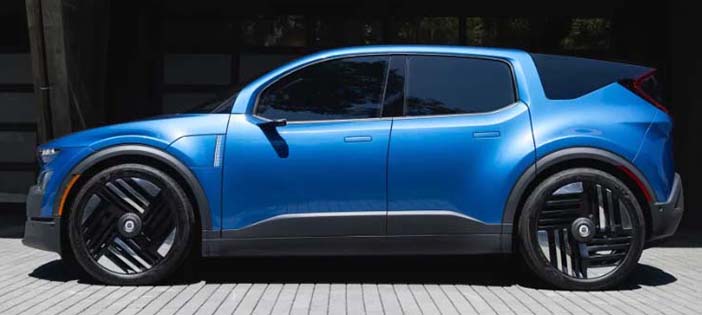
+++ Just a few weeks ago, FISKER showed off the future of its electric lineup at its “Product Vision Day.” Among the highlights was the new compact Pear, which is intended to arrive with a sub-$30,000 price point and be an affordable alternative to the likes of the Nissan Leaf. While the Pear isn’t quite ready for prime time, Fisker has shared a host of photos to accompany a few new details about this budget-friendly EV. I now know the Pear will measure approximately 4.550 mm and will be offered in both 5- and 6-seater configurations, further enhancing what already promises to be a flexible and utilitarian platform. The cargo section is referred to as the Pear’s “Houdini trunk”, which allows access to the hatch area in tight nose-to-tail parking situations or low ceiling heights thanks to a rear glass section that opens downward into the rear load floor, rather than swinging up and out like a normal hatch. Fisker also hopes to launch the Pear with exterior camera mirrors, but those are still under review due to regulatory requirements. And then there’s the “froot”. Think frunk, only British, or vegetarian. It’s a sealed front storage compartment intended to store things that should be isolated from the cabin, like sweaty workout gear or pungent leftovers. Fisker says it will even offer an insulated option for storing temperature-sensitive items. Gig drivers, take note. The cabin itself is “designed to be extremely durable, with no fragile moving parts”. Fisker calls it a boon for families and ride-share drivers, but there’s also an upside for the manufacturer that consequently doesn’t have to bother with expensive physical controls. Fisker says the Pear will also have a “Lounge Mode” that allows all of the seats to fold completely flat to create a relaxation or sleeping area along with a rotating, 17-inch screen to provide entertainment while you’re stretched out. The 6-seater option replaces the single front passenger seat and center console with a large 2-seat bench. Fisker also appears close to finalizing the Pear’s electric range. Previously, the company said it was hoping to deliver up to 500 km on the EPA test cycle. Fisker has revised that up to 510 km on the high end. In addition, it’s offering a target for the smaller, city-oriented battery pack that is expected to come standard at the Pear’s $29,990 starting price. The base model should manage 290 km on a single charge. +++
+++ Immediately after taking the helm ar MAZDA , newly appointed president Masahiro Moro, who took office on June 27 in the first leadership change in 5 years, flew to China. “We are finally going to start full-scale operations here”, he wrote in an email sent to people involved, determined to turn around sluggish China sales as his first mission as president. Mazda’s sales in China in the year from April 2022 had halved from the previous year to 84.000 units. The main reason was a thin lineup of electric vehicles popular in China, with the MX-30, launched in the autumn of 2021, being the only EV model for the Chinese market. While other companies launched new models one after another, Mazda sold only about 200 units of the MX-30 in fiscal 2022, which ended in March this year. In fiscal 2023, the company aims to achieve a 50% increase in sales in China. Although a new EV model, which Mazda sees as its “main product”, will not arrive in time, the company is pinning its hopes on the CX-50 hybrid vehicle set to be put on sale in the fall. With this SUV, which was originally planned for the North American market, the company aims to attract customers looking for cars for outdoor activities. For carmakers, electrification is now a prerequisite for complying with environmental regulations in various countries. In China, in particular, sales of EVs and other environmentally friendly vehicles account for a quarter of all new vehicles sold. The Chinese government’s generous support for EVs, including subsidies and tax breaks, has led to their rapid sales expansion and fierce price competition. “China is going straight into electrification”, Moro said, with a sense of crisis. “Some customers are coming into dealerships only to buy EVs”. Mazda will introduce new electric models to the Chinese market, including fully electric and hybrid vehicles, every year from fiscal 2024. China has been the world’s largest market in terms of new vehicle sales for 14 consecutive years. Mazda plans to accelerate its shift to electrification through joint ventures with local companies in order to “capture the revenues it had failed to generate”, a company official said. In markets other than China, however, Mazda is not necessarily rushing to electrify its vehicles. The European Union, which had tried to ban the sale of new gas-powered vehicles by 2035, has made it possible to continue selling the vehicles on the condition that synthetic fuels are used. In the United States, policy directions differ from state to state. “We will not be the front-runner in EVs, but rather a willing follower until 2030”, Moro says. While making profits with its existing models (especially its large SUVs) the company will spend time on developing technologies for batteries and powertrains. Mazda plans to launch EVs on a full-scale globally from 2028. There is already demand for EVs made by the company. Tomohiro Hatanaka, general manager of the new car sales division at Mazda dealer Enfini Hiroshima, said, “Some companies only use electric and hybrid vehicles as company cars”. Expectations for EVs will likely grow also among individual customers looking for Mazda’s “fun to drive” features. Moro says environmental responsiveness is a prerequisite as a carmaker, while the firm’s mission to deliver a “joy of driving” must also remain intact in the future. EVs have the potential to deliver on both of those goals. As long as Mazda is committed to being a “follower”, it is expected to demonstrate its uniqueness in vehicles’ performance and ride quality, and offer values that surpass those of its rivals. “We will mass-produce the excitement of the mobile experience”, Moro said. Toshio Uno, an executive at auto parts manufacturer Hirotec, says the company must take on the challenge of developing EV parts even if it’s costly. Since last August, Hirotec has been developing production technology for EV powertrains at a joint venture with fellow parts-makers Hiroshima Aluminum Industry and Ondo, along with Mazda. EV powertrain components include electric motors and electronic control units, and EVs don’t need the mufflers Hirotec manufactures. While a gasoline-powered car is said to have about 30.000 parts, an EV needs about 20.000, which means that electrification could change not only the structure of cars but also the automotive industry as a whole. Mazda estimates that in the Chugoku region there are about 10.000 workers involved in the production of internal combustion engines, including those who work at parts suppliers. “In order to maintain the industry and employment, the entire supply chain, including our business partners, must change its business models”, said Ichiro Hirose, Mazda’s director and senior managing executive officer. The establishment of the joint venture with local parts manufacturers is the first step in such efforts. Mazda will invest ¥1.5 trillion in its shift to electrification by 2030, including through collaborations with its business partners. Money will be spent on a wide range of research and development, including that for EV motors and batteries, but there is no guarantee that all suppliers will be involved. Some component-makers are already facing headwinds. A top executive of a local parts manufacturer complained, “If the parent (Mazda) doesn’t pursue volume, we won’t be able to make a profit”. The parts-maker’s sales in the most recent business year were down slightly from the previous year, while Mazda posted record sales. In the fiscal year that ended in March 2022, Mazda’s break-even point was below 1 million units, as it improved production efficiency amid parts shortages caused by the pandemic and it also raised unit prices. While Mazda’s business foundation has become stronger, parts suppliers suffered, as their basic strategy is to sell in large volumes. Mazda has indicated that it will expand cooperation with local suppliers beyond powertrains. However, an executive at a company that also knows other automakers said, “Many of Mazda’s suppliers are small companies. As the shift to electrification progresses, the shakeout will accelerate. There is the option of switching to a business that does not rely on Mazda”. The semiconductor industry, backed by government support, has the potential to offer opportunities for local suppliers. As was seen in a massive investment by Micron Memory Japan at its Hiroshima plant, there is growing space for related firms to do business in the industry. Akinobu Teramoto, director of the Research Institute for Nanodevices at Hiroshima University, welcomes a possible shift in business models. “Parts manufacturers can advance into chip production equipment if they accumulate expertise in fields such as clean rooms”, he said. Mazda’s latest drive for electrification is not the first time local suppliers have been affected by larger firms’ strategies. The semiconductor industry is also undergoing changes. Amid such a volatile environment, Mazda and parts manufacturers are trying to find a new balance in how closely they work together. +++
+++ Batteries in older NISSAN LEAF electric vehicles are getting a new life as portable power sources that can be used to run gadgets on the go or deliver emergency power in disasters. Nissan has sold more than 650.000 Leaf EVs. Their batteries often retain a charging capacity longer than the car’s life span. Nissan says it is using the old batteries in portable power sources it developed with electronics maker JVCKenwood Corp and 4R Energy Corp, a company co-owned by Nissan and Sumitomo which works on ecological vehicles and power storage systems. The 14.4-kilogram power source sells for 170.500 yen in Japan. Overseas sales are not yet set. Each Leaf uses 48 battery modules. The portable power stations contain 2 modules. Nissan officials said they are testing the batteries in Leafs after their owners stop driving them, and reusing those that can still hold a charge. EV batteries use expensive rare metals and other raw materials, and their manufacture produces carbon gases, so reusing them for other purposes helps sustainability. Balakumar Balasingam, an associate professor of electrical and computer engineering at the University of Windsor who isn’t involved in the Nissan project, said batteries can no longer be used to drive electric cars when their charge capacity declines to about 80%, but can still be used for other purposes. “Retired EV batteries have great potential in energy storage applications”, he said. “Without such a solution, billions of EV battery packs will be made and then prematurely recycled in the next decade. That will be a problem for sustainability”. +++
+++ POLESTAR ’s operating loss narrowed in its second quarter as the auto industry slowly recovers from pandemic-related supply chain bottlenecks. The cash-strapped Swedish carmaker, founded by China’s Geely and Volvo Cars, posted an operating loss on Thursday of $274.4 million, down from $627.3 million a year ago, while revenue rose to $685.2 million from $589.1 million. Polestar said it delivered 15.765 vehicles during the quarter, and reiterated its forecast to deliver between 60.000 and 70.000 cars in 2023 and achieve a gross margin of 4%. Polestar cut the delivery target from 80.000 in May. Delayed production starts, job cuts and mounting competition from new Chinese rivals have meant a tough year for the company. Polestar has also faced increased competition from more established EV makers. While some have cut prices to boost demand from consumers grappling with higher living costs, Polestar has maintained its premium pricing. Although it has inched closer to profitability, Polestar continues like rivals to struggle with previously high raw material prices that, due to a lag, put pressure on the second quarter margin, despite prices on the materials such as lithium, cobalt, and nickel falling. Polestar CEO Thomas Ingenlath told he expected lower raw material prices to have a positive impact on the second half of 2023, supporting the company’s 4% gross margin forecast. Polestar posted a net loss per share of $0.14 in the quarter, compared with $0.12 a year ago. Cash and cash equivalents at the end of the quarter were $1.06 billion, compared with $884.3 million in the preceding three-month period. +++
+++ With the vehicle inventory shortages of the past few years, it’d be easy to assume that most new models fly off dealers’ lots as soon as they land. While that certainly is the case with some vehicles, iSeeCars recently updated its fastest-selling cars study with data on the SLOWEST SELLING models in the market. iSeeCars’ executive analyst, Karl Brauer, said, “Dealers and manufacturers have typically targeted 60 days as the time to sell a vehicle, though that number dropped dramatically during Covid due to shortages in new and used car supply”. He noted that the 10 slowest-selling used cars all took longer than 60 days to sell on average, and all of the slowest-moving new cars averaged more than 80 days. On the used car side of the house, some of the 10 slowest-selling vehicles are: Tesla Model X: 71.4, Cadillac XT4: 71.9, Land Rover Discovery Sport: 73.6, Ford Mustang Mach-E: 75.8 and Tesla Model S: 88.3. The 10 slowest-selling new cars took so long to move that they made the used cars look like rockstars in comparison. Though there’s only one EV on this list (the Nissan Leaf) electric car sales have slowed dramatically in the past year. The list of slow-selling new cars includes: Ford Edge: 93.6, Nissan Leaf: 95.2, Mazda MX-5: 107.3, Ford Mustang: 108.6, Land Rover Discovery Sport: 119.4 and Jeep Cherokee: 128.7. Overall, used cars sold in 49 days on average, which iSeeCars noted as an improvement over a year ago. At the same time, new car sales have slowed by 25.7 percent, and electric vehicles of all types take twice as long to sell on average than they did in the previous year. While that’s not the best news for automakers, it could mean better prices and a stronger negotiating position for buyers in the finance office. +++
+++ TOYOTA ’s global production rose 10% last month to a July record of 918,347 vehicles on robust demand and further easing of pandemic-related disruptions. Worldwide sales, including for subsidiaries Daihatsu and Hino, rose 5.2% to 918,345 units on strong demand in North America, India and the Philippines, the world’s biggest automaker said Wednesday. Sales in China fell amid intense competition with local brands. Toyota on Tuesday suspended production at all of its Japanese plants after a rare system malfunction made it impossible to order parts. The plants started to gradually resume operations Wednesday, and the company said it doesn’t suspect that it was the victim of a cyberattack. Separately, Honda said global sales fell 1.9% from a year earlier to 314.146 units, the first decline in 4 months. Honda’s production slumped 19.2% due to weak output in China, although the company produced a large number of cars in the U.S.. Nissan said it produced 271.505 cars in the month (down 4.7%) for the first drop in 6 months. Sales dipped 0.5% to 264.894 vehicles. Toyota restarted operations at its plants in Japan on Wednesday, after a system glitch the previous day brought production to a halt at all of its 14 domestic factories. The malfunction affected a system that processes parts orders. An alternative system was currently being used to procure parts, according to the automaker. Production resumed Wednesday morning at 12 plants, including the Motomachi and Tahara plants in Aichi Prefecture and Toyota’s Iwate Plant in Iwate Prefecture. Toyota’s Miyata plant in Fukuoka Prefecture and the Kyoto Plant of Daihatsu expected to resume operations later in the day. Toyota’s factories in Japan produce about 30% of the world’s vehicles, including the Yaris and Corolla models. The automaker is investigating the cause of Tuesday’s glitch, which it does not believe was triggered by a cyberattack. +++
+++ The UNITED STATES is making $12 billion available in grants and loans for automakers and suppliers to retrofit their plants to produce electric and other advanced vehicles, Energy Secretary Jennifer Granholm told reporters on Thursday. The president Biden administration will also offer $3.5 billion in funding to domestic battery manufacturers, Granholm said. For the advanced vehicles, $2 billion of the funding will come from the Inflation Reduction Act which Democrats passed last year, and $10 billion will come from the Energy Department’s Loans Program Office, Granholm said. Speeding grants and other subsidies to fund conversion of existing auto plants to build electric vehicles could help the White House blunt criticism from automakers and the United Auto Workers (UAW) union over proposed environmental rules aimed to help usher in the EV era. The UAW has warned that such a rapid change could put thousands of jobs at risk in states such as Michigan, Ohio, Illinois and Indiana. Shawn Fain, the UAW president, has campaigned to save a Jeep factory in Belvidere, Illinois, that Stellantis has put on track to shut down. The automaker has left open the possibility that the factory could get a new product with government aid. +++
+++ Chinese electric car giant XPENG said Monday it would buy the EV subsidiary of ride-hailing platform Didi for more than $740 million and launch a new brand of vehicles. Founded in the southern province of Guangdong in 2015, XPeng is one of dozens of Chinese startups to emerge in recent years to take advantage of the boom in electric vehicles in the world’s largest auto market. Didi is China’s leading car-hailing app but also operates a subsidiary designing electric vehicles. In a filing to the Hong Kong Stock Exchange (where XPeng is listed) the car giant said it had reached a deal with Didi to buy that subsidiary for $744 million. XPeng will also partner with Didi to launch a new brand of electric vehicles next year. Markets welcomed the deal, which allows the Chinese manufacturer to eliminate a potential competitor and gain access to its advanced technology. XPeng shares gained almost 13 percent Monday morning. The brand (which also markets some of its products in Europe) employs around 14.400 people and has offices in Silicon Valley and Amsterdam. XPeng sold 41.435 vehicles in the first half of 2023, down 40 percent year on year, according to results published this month. China, the world’s largest emitter of greenhouse gases, is aiming for the majority of car sales to be electric and hybrid by 2035. Generous purchase subsidies have fueled a boom in EVs in recent years, driven by firms such as BYD, Nio, XPeng and others. +++