+++ If you’re into cars that actually make you feel something when you drive, you’ve probably imagined yourself behind the wheel of an M3. I certainly have. It’s one of the best performance sedanse. But just below it in BMW ’s line-up sits the M340i, a more affordable option that blends serious power with the kind of comfort and practicality you can actually live with every day. While BMW works on the next-gen M3, which will come in both combustion and electric versions, engineers in Munich are also quietly preparing a new version of the more attainable M340i. That model is about to evolve, with some key updates to keep it competitive in the brand’s shifting performance line-up. The replacement will be called the M350, part of BMW’s effort to update its model naming for the Neue Klasse era. The familiar ‘i’ is being dropped, now reserved exclusively for electric models. The numerical jump from ‘40’ to ‘50’ also points to a performance boost. Unlike the next-gen electric 3-Series, to be named the i3, which will shift to BMW’s Neue Klasse platform, the refreshed petrol range is expected to stick with the current CLAR underpinnings. Like the M340i, the M350 will be powered by BMW’s 3.0-liter turbocharged six-cylinder B58 engine, albeit modified to produce upwards of 400 hp, possibly flirting with the 420 hp mark. That’s a solid jump from the current 384 hp, particularly when you consider the B58 is being updated to comply with Euro 7 regulations, bringing its performance even closer to today’s M3. Rear-wheel drive and all-wheel drive versions are expected to carry over, along with the same eight-speed automatic transmission. If you’re holding out hope for a manual option, you might want to sit down. It’s not impossible, but very unlikely BMW will go that route here. On the design front, the M350 will be refreshed with some of the Neue Klasse styling cues we’ll soon start to see across the brand. Expect a redesigned front end featuring slimmer headlights and a wider, slimmer version of BMW’s kidney grilles. Out back, the prototype wears quad tailpipes and a subtle lip spoiler, with big wheels wrapped in low-profile tires hinting at the car’s performance credentials. The overall shape stays classic 3-Series, with a traditional three-box silhouette and a fresh take on BMW’s signature Hofmeister kink at the rear door. Based on what BMW has revealed about the next 3-Series, the interior will be a major departure from what we know today. Expect the company’s new ‘Panoramic iDrive’ layout, which ditches the conventional instrument cluster. Instead, a full-width display sits at the base of the windshield, showing driving info directly in front of the driver, with customizable modules on the right. The infotainment setup will also include a large trapezoidal screen at the center of the dashboard. Production for the next-generation 3-Series, including the M350, is set to begin in late 2026. That means it’ll be a while before we see the finished product in person, and even longer before anyone gets the chance to put it through its paces on the road or track. +++
+++ BYD sees China’s electric-vehicle price war as unsustainable, according to a senior company executive, who stopped short of saying the country’s largest EV maker would scale back the aggressive discounting it helped trigger. “It’s very extreme, tough competition”, said executive vice president Stella Li in an interview. “It’s not sustainable”. The comments highlight mounting strain within China’s overheated EV market, where a flood of new entrants and deep price cuts (many led by BYD) have eroded margins and triggered rare government intervention. While BYD has gained market share, the fallout is growing, with investors, regulators and rivals all pushing for a reset. The EV price war has weighed heavily on automaker shares, with BYD losing around $22 billion in market capitalization since peaking in late May. Still, the company is seen as a likely long-term winner if smaller and mid-sized rivals are squeezed out, allowing BYD to grow its dominant market share. +++
+++ It’s been 2 years since LAMBORGHINI did the unthinkable: introduced an electric car, albeit only as a concept. A production version of the Lanzador isn’t coming anytime soon, as the model’s launch has already been delayed by a year. The 2+2 grand tourer is now planned for 2029. In the meantime, it’s business as usual. In fact, the Italian exotic brand has no plans to retire gas engines anytime soon. Chief Technical Officer Rouven Mohr told that Lamborghini aims to keep internal combustion engines for “as long as possible”. He remains confident that the venerable ICE hasn’t reached its full potential: “We still think that we have a lot of ideas to transport, let me say, the combustion future”. Whether that future involves synthetic fuels remains unclear. However, the Sant’Agata Bolognese-based automaker has repeatedly said that e-fuels could be the saviour of combustion engines. Whatever the case, Mohr explained that Lamborghini’s decision to keep ICE in the long run is rooted in the emotional thrill electric powertrains can’t deliver. It’s that emotional connection that allows Lamborghini to remain “the pinnacle in emotion”. Even so, Lamborghini has had to make compromises to meet stricter emissions regulations. The new Temerario skips the naturally aspirated V10 engine of its Gallardo and Huracan predecessors. Instead, it’s powered by a smaller, twin-turbo 4.0-liter V8 as part of a hybrid powertrain. Similarly, the Revuelto is also electrified, although engineers managed to retain the iconic V12 engine. Much like its 2 supercars, the Urus has also been converted to a hybrid, marking the end of Lamborghini’s petrol-only era. Meanwhile, archrival Ferrari has largely electrified its line-up and will (partially) unveil its first electric car this October. The Prancing Horse maintains it will still be a true Ferrari, while Lamborghini insists it needs more time to create an electric car worthy of the Raging Bull badge. Lamborghini isn’t rushing to add a 4th model to its line-up. The Urus is sold out until 2026 and the Revuelto until 2027. The company had record sales in 2024, with deliveries up 5.7% to 10.687 vehicles. Unsurprisingly, the Urus did the heavy lifting with 5.662 units sold, followed by the Huracan (3.609), the Revuelto (1.406) and the final 10 units of the Aventadors. Production of this car had to be restarted after several Ultimae models perished on the burned and sunken Felicity Ace cargo ship. While Lamborghini plans to continue building V8 and V12 cars for the foreseeable future, it remains committed to becoming net carbon neutral by 2050. In Europe, however, the company may be forced to abandon ICE sooner if the EU enforces its proposed 2035 ban on new vehicles that produce emissions, and if synthetic fuel production doesn’t scale up in time. +++
+++ Stellantis needs to take urgent action to revive MASERATI after sales plummeted by 57% last year, dropping to just 11.300 cars. The Trident’s parent company has denied reports that it plans to sell the Modena-based marque and insists it has no intention of shutting down the storied luxury brand. So, what’s the plan? Help Maserati from within by working more closely with another automaker located just about 250 km away. Alfa Romeo, which isn’t exactly thriving either, will join forces with Maserati. Santo Filici, CEO of both brands, says a plan has been drafted but still needs approval from Stellantis’s new top brass. The conglomerate’s CEO, Antonio Filosa, is scheduled to meet with representatives from the two Italian marques on June 23 to finalize the details. Filici told that Alfa Romeo and Maserati will collaborate on the development of new cars. A merger appears to be off the table, as the CEO has previously stated that the brands occupy different positions within Stellantis. Alfa is “premium”, while Maserati is “luxury”. Even so, the 2 companies are expected to consolidate efforts in other areas to reduce costs by “finding synergies where is possible”. “Of course, we are touching vehicle development. It’s one of the pillars that’s in this plan that we are going to close. For sure, we are also touching other columns, meaning organization structure, our dealer network footprint and considering our plants here in Italy. There is a big job to do. We are going to close this plan”. Regarding what went wrong at Maserati, former Stellantis CEO Carlos Tavares stated that the products were fine, but poor marketing led to a lack of clear brand positioning. Elsewhere, the fully electric MC20 has been cancelled after the company realized that the rich still prefer combustion engines. The next-generation Quattroporte, which will also replace the Ghibli, has been pushed back to 2028. Alfa Romeo faces its own challenges, as the launch of the next-generation Stelvio and Giulia is taking longer than expected. Initially planned solely as EVs, both models will also receive combustion engine variants, requiring additional engineering. Like many other automakers, Alfa recently abandoned its EV-only strategy. +++
+++ At STELLANTIS , chairman John Elkann called on the European Union to approve rules that would allow automakers to again build inexpensive small cars in a profitable way. As recently as 2019, one million cars that cost less than €15.000 were sold in Europe (€18.000 in the Netherlands), but now that figure is only about 100.000, Elkann said at a congress in Turin, Italy. He suggested that Europe look to Japan, where lightweight, inexpensive kei cars have long had significant market share. Europe’s version of the kei car could be called the E-Car, he said. +++
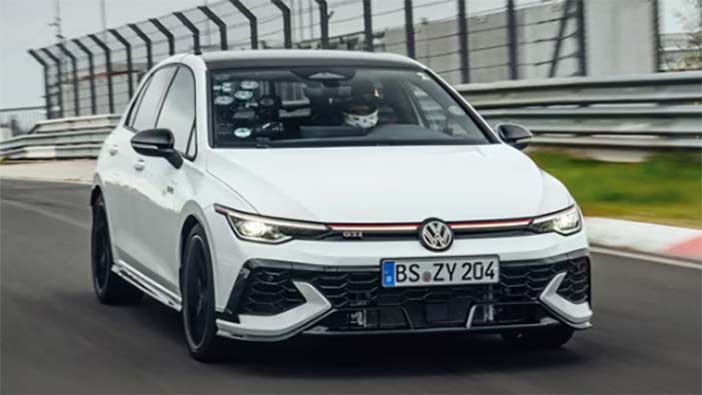
+++ The upcoming VOLKSWAGEN GOLF GTI Edition 50 has become the quickest production-based VW model to lap the Nürburgring, surpassing even the more powerful and track-honed Golf R. The special iteration of the hot hatch (based on the current Golf, which is widely expected to be the final pure-combustion GTI before the badge moves into the electric era) lapped the 12.94-mile Nordschleife circuit in 7 minutes 46.13 seconds. The lap was set a little over a week before the 2025 Nürburgring 24 Hours, where the GTI Edition 50 is planned to be officially unveiled on 20 June. While the special Golf won’t reach showrooms until 2026, it has already made headlines by eclipsing the time set by the Golf R 20 Years, and has edged the Golf closer than ever to the 7 minutes 44.88 seconds front-wheel drive Nürburgring lap benchmark set by the Honda Civic Type R in 2023. In beating the four-wheel drive Golf R 20 Years (a 333 hp anniversary model that set a time of 7min 47.31 seconds in 2022) – the new front-drive GTI Edition 50 has now leapfrogged what was once considered Volkswagen’s halo performance Golf model. The GTI Edition 50’s lap time was achieved by Benny Leuchter, Volkswagen’s long-standing development and race driver. Technical details of the Edition 50 remain under wraps but the Nürburgring car had the Performance Package, which included Bridgestone Potenza Race semi-slicks on 19 inch forged Warmenau wheels and a revised suspension set-up. These components are expected to be optional extras when the car goes on sale in late 2025. Power output hasn’t been confirmed, but it’s understood the Edition 50 will produce close to 333 hp from its familiar turbocharged 2.0-litre four-cylinder EA888 petrol engine, paired with a 7-speed dual-clutch gearbox and a mechanical limited-slip differential. Leuchter emphasised that the car he drove wasn’t a one-off. “Technically, it was set up exactly as it will be sold to customers”, he said. +++
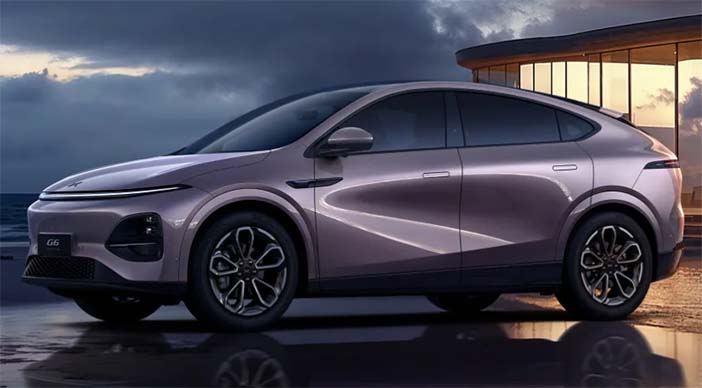
+++ After being on sale in the Netherlands for less than 2 years, the XPENG G6 has received some seismic updates that increase the maximum charging speed of the Tesla Model Y rival from an already impressive 280 kW to an astonishing 451 kW, making it one of the fastest-charging electric cars in the world. There aren’t any ultra-rapid charging points capable of those speeds yet. However, if you were to plug the updated G6 into one of the 500 kW units in mainland Europe, XPeng says recharging from 10 to 80 per cent will be done in just 12 minutes. The company has managed to achieve this by fitting a new ‘5C Supercharging’ lithium iron phosphate (LFP) battery. XPeng hasn’t said how big this new battery is or what range it offers, but it is apparently more eco-conscious because it eliminates the need for expensive, resource-intensive minerals such as cobalt and nickel. It’s combined with an 800 volt electrical architecture, similar to what you find in the Hyundai Ioniq 5 or Porsche Taycan. Elsewhere, the G6 now has a sharper, more futuristic look now thanks to the addition of a full-width LED lightbar at the front, and a redesigned rear diffuser, plus a new Stellar Purple paint colour is available. At first glance, the interior looks to be the same as before, but XPeng has fitted a new dashboard, ambient lighting, a capacitive steering wheel and more premium materials. The front seats now feature a massage function with lumbar support too. The updated XPeng G6 will be on display in the Village at this weekend’s Le Mans 24 Hours race in France; it’s due to go on sale in Europe in mid-July. +++